Wednesday, 18 May 2016

Staying at the Pazo de Adran (Part 2)


At the top terrace is this intriguing detour downwards.  Beyond the gate is some secret passageway...
At the top terrace is this date palm.
Looking onto the second-top terrace...
This is the view outside our room - two levels up from the pool
Looking beyond the boundaries of the Pazo de Adran.  In the foreground is a lovely Japanese maple.  We also saw bottlebrush, camellias, azaleas and a variety of other plants.
This is our room.
Our room
Neil, Carolyn, Jean and I enjoyed the private dining area..
Ann, Linda, Rhian, Neil and Jean.

Staying at the Pazo de Adran (Part 1)


This is our hotel for the evening of Day 6 of our walk - the Pazo de Adran - an 18th century ancestral home, situated on sloping land which has been carved into six separate terraces.  The bottom terrace has the pool.  When we arrived around 3pm, we found all the British ladies sunbathing at the pool's edge.
Around the back of the main building is the pool - I swam, but the water was freezing.
Two levels up from the pool is this pretty pergola covered in wisteria.
One level up from the wisteria is this row of mandarin trees.  Neil and I tried a couple.
Near the wisteria...
These stairs start three levels up from the pool.
One level up from the pool, we spent a lot of time sitting here, sharing travel stories with the British ladies over a drink or two - I had two glasses of port.  Here in Spain, as in Porugal, you can't ask for 'port' in an Australian accent as they won't understand.  You have to force a local accent - and then port is served.
Jean talks to Ann, a Welsh nurse who spent time in Aberystwyth, beneath the camellias.
Two levels up from the pool
Four levels up from the pool.  All the levels are joined by stone steps or sloping pathways.

Padron to Teo

Our second-last day on the Camino involved about four hours of walking only.  We departed our hotel at 9.30, passing through the central area of Padron and heading back out into the country, passing, as usual, through rural scenery incorporating small villages, fields, large vegetable plots, and roads including the N550 which seems to be the main north-south artery in Galicia.  After we'd walked nearly seven kilometres, we stopped for coffee; and, after about 14 kilometres, we stopped for lunch.  I had a Spanish omelette.  We continued on until about 2 pm or so, when we reached Teo, our destination for today.

Leaving Padron

In Spain, there are many abandoned buildings such as this.  They serve their purpose, and for some reason are no longer used.  It may be a question of money.  Often, when the roof collapses, the building is abandoned.
Here, Neil and I are about 150 paces behind Jean and Carolyn.
Having arrived in Teo, we stopped for several minutes under this oak.  A little later, we strolled down the hill to the left.  Teo is extremely tiny, and we jokingly asked ourselves whether we'd seen the 'Welcome to Teo' sign.  Of course, Teo is so small, there wouldn't be one.  We telephoned the hotel just outside Teo (Pazo de Adran) to come to collect us as according to the instructions.  We were stunned when the driver turned up in a London taxi.

This London cab is one of the old style Austins, exactly as they looked back in the 80s when I lived in London - unlike the silly looking type they have these days.  But seeing this London cab on a bright sunny day instead of in drizzly English rain, somehow it didn't look right.

Sunday, 15 May 2016

Caldas de Reis to Padron

Day 5 of the Camino and our first sunny day!  We couldn't believe it - the sun actually came out.  For the ladies we know who have walked from Porto, it was even more welcome.  Between Porto and Baiona, for them, there was torrential rain.  For us, it's been steady at worst.  But at least our shoes (mine are moabs) have not got wet, whereas our fellow-Camino walkers' socks were soaked back in Portugal.  

In the rain, I miss the scenery because I tend to walk with my head down, seeing only about the first three metres in front of me.  Then, I'll realise mud is at my feet and I need to step to the left or right.  Carolyn and Neil, who both wear glasses, complained of them fogging up.  I also wear glasses, but I wasn't worrying about that.

The scenery was not any different today to the scenery we've encountered thus far.  Lush green hills and fields, great quality soil, vineyards, rivers, creeks, stone houses, vegetable patches, villages, centuries-old churches, and the ubiquitous track, trail, pathway, lane way, and road as well as the ever-present Camino arrows and scallops guiding us ever forward.

While walking this long distance, I can't help thinking back into history.  I'm reminded of the Second World War when many European women prisoners of the Japanese were made to march hundreds of kilometres through harsh, humid, mosquito-infested terrain.  And I remember Allied prisoners of war, in early 1945, who were forced to walk westwards away from the advancing Russians in freezing conditions.  In both cases, many died along the way.  But here we are complaining there aren't enough coffee shops on our Camino or not enough toilets or, especially in my case, not enough quality access to the Internet.

Remarkable...we have shadows....the sun's out at last!
It's the first time sheep have blocked our path.

Neil placing stones upon a Camino sign.
Beneath the arrow, it says 'P.K. 33.089'.  This means the distance to Santiago de Compostela is 33.089 kilometres.  We will reach Santiago the day after tomorrow.  Having walked at least 90 kilometres, I feel we're almost there!
Some of the English and Welsh ladies...and Neil

Heading into Padron, our destination for today.
In this pretty park in Padron are many plane trees, a popular tree found all over Europe.

Photos Pontevedra to Caldas de Reis

In Pontevedra
The Ponte Burgo in Pontevedra
In the rain
At a coffee/Estrella stop
The elderly American ladies I chatted to
A Galician man working his vineyard
Some of the mud we had to walk through
Here, granite blocks have been placed in the ground upright.

From Pontevedra to Caldas de Reis

It's Day 4 of our Camino walk.  When we reached our destination today, Caldas de Reis, we had covered about 80 kilometres of the Camino trail, including today's 23 kilometres. There is some 40 kilometres ahead of us over the next few days.  

Today, the terrain was not unreasonable, but it was muddy here and there.  We passed through more lush, green fields, dense bushland, and lonely tracks.  Last night, we ditched a lot of stuff from our day time carry bags, and today just carried the one bag between us, which we shared.  I have to say I much prefer carrying nothing when walking long distances.  Otherwise, I don't know how anyone enjoys it.

A regular and unwelcome Camino companion has been the 'unseasonal' rain.  After we left picturesque Pontevedra this morning, and crossed over the Ponte Burgo, there was no rain for about an hour.  It then rained for at least two hours.  For the rest of the day, there was no rain, but occasional patches of mist.

We continue to see familiar faces, such as the English ladies and Welsh ladies who are staying at each of our hotels, and, like us, have booked this Camino through Camino Ways, an Irish company.  We continue to see Richard, who is walking together with his nearly 80 year old mother.  Richard has walked many different Camino routes, and is writing a book about it.  He has a website: marymichaelpilgrimsway.org. We met a young Ukrainian woman who has lived in Portugal for 10 years and who believes she now speaks better Portuguese than Ukrainian.  I saw the German lady from yesterday, and I said "Ich gruesse dich".  More appropriately, I should have said "Ich gruesse Sie".  But she smiled and greeted me back with "Ich gruesse dich". And we met a small army of elderly American women who, full of enthusiasm, are walking at least their second Camino.  

The American ladies' first Camino was the final stretch of the Way of St James.  One of them said that on that route there was no lack of coffee shops and facilities, unlike this route in which you have to pray for coffee to come up soon.  On this route, you also have to pray for the toilet to come up soon.

I feel sorry for women walking the Portuguese Way.  If one is in the middle of nowhere, a woman must often just hold on and hope to encounter a toilet soon.  Men, on the other hand, can 'pick their moments', and hide behind a bush, or take advantage of a secluded bend in the road where a field of weeds has grown quite high.  At one point today, I 'picked my moment', running on ahead of Jean at a time when we were well ahead of the American ladies, and quite a way behind others including Neil and Carolyn.  When Jean caught up to me, she gasped.  My hand was brushing against a stinging nettle.  I poured water on it in a bid to avoid any stinging sensation.  Throughout the afternoon, however, my hand has stung somewhat.  When it comes to stinging nettles, I should have known better.  Needless to say, matters could have been far worse.

In the last two hotels, my phone has managed to get the Internet at least a part of the time.  However, my iPad, from which I publish my blog posts, has failed to connect.

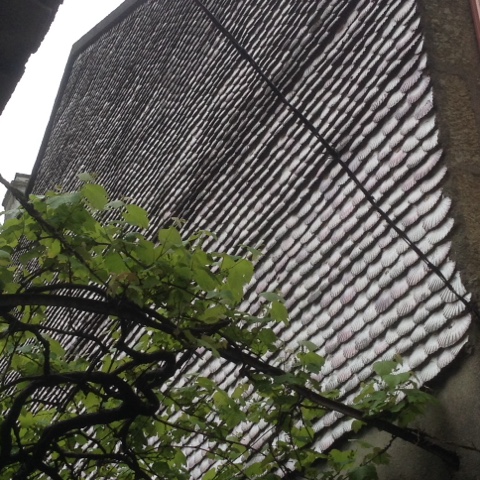
A roof with scallops as tiles


Friday, 13 May 2016

Signs and symbols

Now that we've caught up with the main part of the Portuguese Way, we see the scallop a lot more than before.  The scallop is used not only as a guide for travellers or pilgrims but also by locals.  In the picture below, the home owner has created this scene on an outside wall something akin to a nativity scene.

We entered the Pontevedra Council area, as shown by two of the signs.  The other indicates we're on the Portuguese Way.
Some scallop signs look rather ancient.
A figure indicating the Camino de Santiago
Occasionally, we see rocks placed on top of Camino signs.  Jean suggests the practice may be similar to the practice of lovers attaching padlocks to European bridges.
The modern Camino shell has a blue background - blue for the European Union.
This shows the Cross of Santiago (La Cruz de Santiago), which, according to Google, may originate from the time of the crusades.
Local advertisers like to use the scallop to promote their products more effectively....
...like in this image which advertises Estrella beer.
Occasionally, you see images of witches in Galicia.  This part of Spain has Celtic connections and a tradition of sorcery.