Friday, 3 June 2016

Auschwitz

There are few words which encapsulate so much horror, terror, and evil as does the word 'Auschwitz'.  These two syllables evoke images of gas chambers, of miserable, naked wretches in striped, filthy, louse-ridden uniforms waiting to die or be killed, of sadistic SS guards and vicious German shepherd dogs, of their high-ranking overseers, ensuring the extermination operations were proceeding efficiently, and of the ovens that burned men, women and children in their thousands every day.  As I entered Auschwitz today, I couldn't help thinking about the millions of families who arrived, herded here in cattle trains, and who parted from their loved ones forever.  I thought of the arriving children crying as children do, not understanding what was happening, and I thought of their parents, sisters, brothers, aunts, uncles, cousins and grandparents who didn't understand what was really happening either.
During the war, there was a total of four camps in use.  Auschwitz I and Auschwitz II (Birkenau) were the main ones.  It is these two that together constitute the Auschwitz Memorial Museum today.  We paid for a guide and visited both.  The above famous photo is the entrance to the camp at Birkenau.
The infamous 'Arbeit macht frei' (work makes you free) sign above the main gate at Auschwitz I.  The sign was meant to bluff and control the arriving prisoners.
Auschwitz-Birkenau was a concentration camp and an extermination camp.  Most who died here were Jews.  Today, Jews come from all over the world to honour and remember the large numbers of people who died.
Jews especially come from the State of Israel like this man above in Auschwitz I...
...and this may be the same man in Birkenau...
This photo depicts a selection process.  Jews have arrived by train; now some will be selected to work, the others will go to the gas chambers.
These are empty gas canisters containing 'Cyclone B' gas, which was used to murder Jews.  'Giftgas' means poisonous gas.
This is a pile of exterminated people's spectacles.
These are items taken from exterminated disabled people, who were usually selected to die.
Many people arriving at Auschwitz brought items such as pots, bowls and the like.
This endless pile, perhaps stretching for 20 metres, of shoes was taken from those who perished.  A similarly endless pile of human hair, which visitors are not allowed to photograph, was not far away.
This is a pile of exterminated people's brushes.
This hall contains the names, faces and identification numbers of a small number of the dead.  Identification numbers became useful because the initial photographs of inmates proved useless when physical appearances changed due to malnutrition and other conditions.
Some of these young people lived only weeks or months.  Angela Mirga, a Pole, survived for five months, much longer than so many others.
This quotation can be found at all former concentration camps.


Thursday, 2 June 2016

Wroclove

We left Castle Czocha this morning, and headed east.  Just before lunch, we stopped in the charming city of Wroclaw, which, in German times, was known as Breslau.  There appeared to be not only one town square but two.  We ate lunch, and found more people have a knowledge of English in the bigger Polish cities.  
Most people who have visited Wroclaw will tell you it's really nice.  We came to this city, pronounced 'vrotswov', for the first time.  We agree.
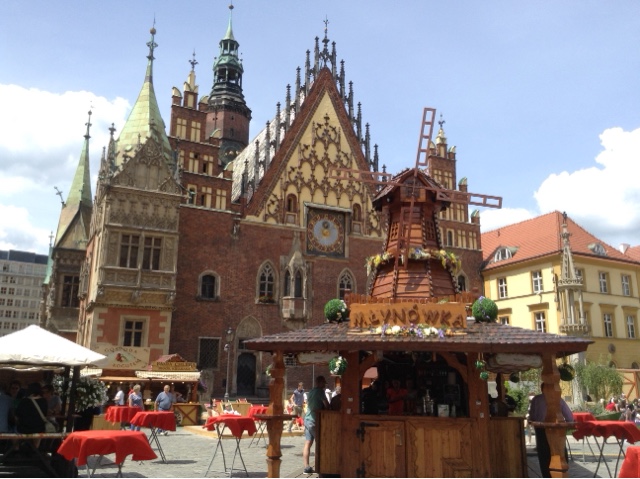
Stalls with food and souvenirs lined one of the squares.  One stall sold fridge magnets advertising the city - one magnet aptly changed the city's name to 'Wroclove'.
Many unusual things could be seen....
....like this little wind mill...
...depicting local culture...
...for special tastes...
...for the mass market....
...or for those who want to indulge.
Like every other European city, Wroclaw has churches...
...but it also has a beach right in the middle of the town square.
Wroclaw, which is the capital city of the Lower Silesian region, also has cultural designs in its pavements.
At first, we thought the reference to dwarves in the above menu was terribly politically incorrect.  Then we realised that somehow dwarves have a place in local culture....
...like in this picture here.

Taking a ship around the lake

We wanted to have a boat ride around the lake beneath the castle.  We knew that a pilot would drive the boat, and that the passenger would enjoy the view.  We also knew, therefore, that the boat would be little bigger than a row- or speed-boat.  So, after I spoke in German to a Polish staff member at the main gate to book the boat trip, the boat trip nearly didn't happen.  Instead, she booked us on a tour of the castle, which we'd already had.  I had smelled a rat when she'd told us we'd be collected from Reception instead of at the main gate.  Luckily, not too much time was wasted before I found out we'd been booked on the wrong tour.  The staff member had misunderstood me.  I had used the German word 'Boot' for 'boat', but the staff member only knew the word 'Schiff' (ship) and assumed we must have wanted the castle tour!!  Sorry, but the vessels you see in the picture below are definitely not ships.

It was pleasant to be on the lake surrounded by the beautiful trees of Lower Silesia - maples, oaks and various pines - packed tightly together in the forests that wrap round the water's edge, casting eternal shade upon the moist and mossy grounds beneath them.
Interesting to get the perspective of the castle from below...

The pilot started playing Polish commentary over his loud speaker.  We told him it was best to turn it off.  No, he didn't have English or German commentary.  If this area wants to open itself up better to the outside world, it will need English as a minimum, and German because of its place in Europe.

After the voyage on the lake, Renate and I circled the castle at ground level.
Near the road, this wall marks the outer boundary of the castle's grounds.
It's a good idea to keep cats in a castle.  They help to keep the mice away.  Today, there mustn't be any mice...
Rain...Lower Silesia gets a lot of heat and then rain and even thunder storms.  A lot like Sydney.

Wednesday, 1 June 2016

A tour of Castle Czocha

This morning we had a short tour of the Castle Czocha, where we are staying for a total of four nights. 
The picture above is the Knight's Hall
I stand near the castle's front entrance.  The Knight's Hall is along the corridor.
The Marble Hall, one of the oldest parts of the castle.  A legend about a crying child is connected with the fireplace in this Hall.  One owner was absent for some time, and returned to find his wife had a child that could not possibly be his.  The wife was drowned in the well of unfaithful wives and the child was walled up alive inside the fireplace of the Marble Hall.
The above is the main courtyard, one of whose features is the well of unfaithful wives.  It is so called because at least a couple of the castle's owners drowned their wives in the well whom they believed had been unfaithful.
This is the Treasury, which is low within the castle complex.  The Treasury was only recently discovered when a new floor was being fitted in the room above.
In the Treasury is a model of the castle.
    
This is the library.  Note the fairly innocent-looking bookcase within its glass doors.
It's actually one of many secret passageways within the castle.  Written records suggest there were around 40 hidden passageways built in the castle, of which only 14 have been discovered.
   
Beneath the Treasury are the steel and concrete reinforced doors.  When the Treasury was discovered, no treasure was found.
The vault
And, from the top of the tower, looking down towards the front entrance to the castle.  At the top of the picture is the main gate.
The lake as seen from the tower
The river Kwisa flows into the lake
The second-floor corridor
Part of the restaurant

There are two theories of the origins of the castle's name.  According to information we received, the name 'Czocha' may be due to the first owners being Czechs.  Or, it may be because the local linen industry process of roughly combing or tousling flax fibres to make linen thread is described as 'czochrac'.

To the top of the Schneekoppe

Possibly most people who climb to the top of the Schneekoppe, or, to use its Polish name, the 'Snezka', use the chairlift, but the four of us took the hard way, climbing to the top on foot.  Parking the car at Karpacz and commencing at 11.30, we climbed up, up, up and further up.  We walked constantly up hill with no moments of walking on flat surfaces. 
It was nearly two hours later when we arrived at the first restaurant about two and a half kilometres up, where we had coffees and lunch.
For the first part, the track was reasonable quality, but then it became like in the above picture - bad for Jean's knee when coming down.
After lunch, we were ready to go, but were prevented from moving on because rain suddenly set in and stayed for ages.
It was after 3 when we pushed on.  It took another hour to climb the remaining stretch.
Several hundred metres from the first stop, we passed a second restaurant.  Outside that restaurant, the above photo shows how much further we had yet to go.
After more than three hours' climbing time, we reached the summit of the Schneekoppe, or Snezka, which is the highest mountain in the Riesengebirge (Giant mountains).  The summit marks the border between Poland and the Czech Republic and is 1602 metres above sea level.

Interestingly, very close by, is the source of the river Elbe, which could be several different trickles of water feeding a larger one, which, further down, clearly becomes the river that stretches all the way to the North Sea.  We've seen the Elbe near its mouth, also in Hamburg and Dresden as well as in the Czech Republic.  Tracing the Elbe back to its source was never intentional.

After about 20 minutes, we then spent the next two hours climbing down again, all of us very proud of our achievement - a tremendous feat but with now very tired feet.